

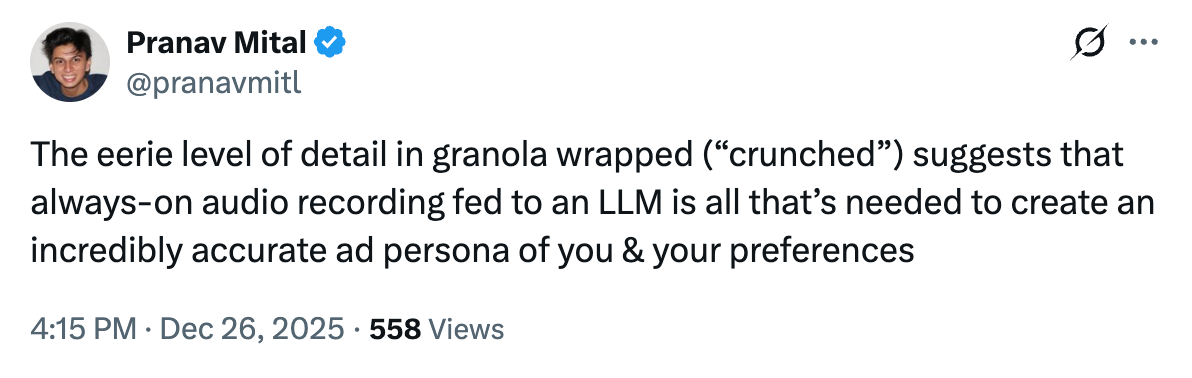
Late last year, the AI note-taking product Granola released a feature called Crunched, their take on an end-of-year, Spotify Wrapped–style recap (Disclosure: Lightspeed is an investor in Granola). Crunched left me stunned. It made me realize just how much Granola had learned about me after transcribing many of my meetings throughout 2025. And judging by my X timeline, plenty of others felt the same. It made me wonder: What does ChatGPT know about me?
So I asked both Chat and Granola what they knew about me. I asked them to get specific, deep, personal. The differences were immediately clear: Chat was great at knowing the things I had specifically asked about: flight hacks, how to interpret my latest blood test results, things I liked to write about (which it affiliated with my interests), and problems I had tried to solve throughout the year.
Granola, on the other hand, seemed to have a deeper understanding of me as a person. My values, relationships, emotional intelligence, actual interests. It knew the things I had said out loud throughout the many conversations it had transcribed. Some of these were in group settings. And some were one-on-ones that bounced between professional and personal subject matter. But none of it specific questions I had asked the AI.
The differences in these two products’ understanding of me made one thing very clear: there’s a stark difference between active context and passive context.
Active Context
Most of what AI knows about us, it knows because we chose to share it. Asking ChatGPT for travel recommendations or daily workout plans is an example of Active Context. Querying Google or Gemini for a phone number or research help is another example.
If you directly and consciously engage with an AI, chances are you’re giving it Active Context. And OpenAI is clearly extremely well positioned to be the King of Active Context given how synonymous it’s become among consumers with AI question answering.
Passive Context
But there’s clearly magic, and potentially even greater value, in passive context. What Granola observes in meetings is one example. Access to our email inboxes is another. Crunched was a mind-blowing experience, but a few months earlier, I had a similarly impressive experience chatting with Poke, which made me negotiate with it to access its subscription tier.
Throughout our negotiation, it became clear that Poke knew an impressive amount about me just by doing inference on my email inbox. As one example, it knew I was both a VC and someone who was actively paying for a Whoop subscription, and therefore assumed I could easily afford a $9.99 Poke subscription.
Companies with significant stores of Passive Context include Google with email and calendar and docs, Apple with messages and email and health data, and Meta with interests and browsing behavior.
What AI Wants to Know
It seems likely that companies with a lot of Active Context will want more Passive Context, and that companies with a lot of Passive Context will want more Active Context.
We’ve seen ChatGPT launch several products aimed at capturing audio (Passive Context), and recent rumors suggest that this functionality will be the focus of their upcoming hardware device. Meta, on the other hand, seems to be investing heavily in consumer AI products, which if they nail would give them access to more direct Active Context.
While both are valuable, I expect Passive Context will ultimately be the more important, especially for consumer businesses. In consumer, products need to eventually be ad-supported (because ads are how consumer products become ubiquitous and available to all).
The consumer AI product that wins will be the one that gets people comfortable with an AI that can passively observe in the background.