
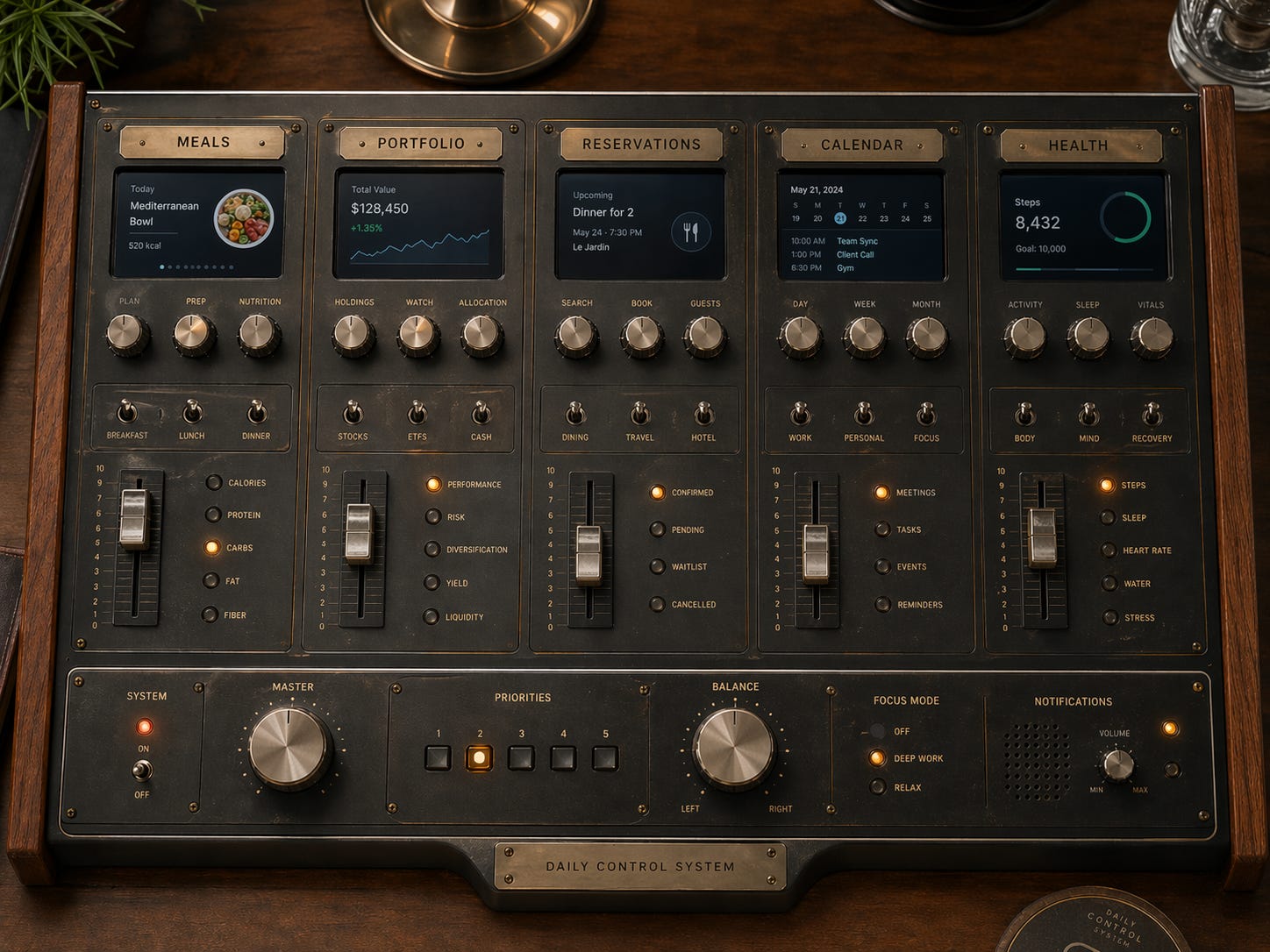
I’m spending a lot of time using AI to build out my own “personal back office.” Many friends, founders I work with, and my partners at USV are, too.
Before AI, it was not feasible from a cost or time perspective to invest in building custom software to help one automate and/or manage various aspects of our non-professional lives. But with AI, we can delegate away tasks that give us superpowers or that we simply find annoying or tedious.
Just a few examples:
I’ve been iterating on an Advisor agent that serves as a public equities advisor. First I used it to translate a specific investment thesis into a strategy. Then, it took that strategy to build me a portfolio that it automatically monitors daily, evaluates for excessive drift or thesis changes, and rebalances as necessary. I may open source this agent soon.
I also have a Nutritionist agent that pulls in all of my personal health data (historical blood tests, x-rays and MRIs, VO2 max tests, DEXA, plus real-time Apple Health data) and maps it against my daily meals to help me hit my current fitness goals. It checks in with me around meal time to make sure I’m logging accordingly, and then lets me know how I’m doing on my calorie and protein goals throughout the day.
Here’s a different kind: my partner Fred Wilson built a Restaurant Recommendation agent that actively monitors a number of his trusted sources for restaurants that it believes he will like and adds them to a database. Then, if Fred wants to eat at any of them, it automatically accesses his Resy, OpenTable, Doordash, and Blackbird accounts to order food, book reservations, etc.
I’m sure many reading this have their own AI “personal back office” stack, too.
There is a real possibility that over the long run, I’ll end up ditching a lot of the stuff I’ve built and that the value will have come more from the fun of building the back office than the actual output. Will Manidis’ excellent essay Tool Shaped Objects captures this well.
But I’m optimistic that for every few abandoned agents I leave behind, something real will stick.
And I’m excited to see the tools other people build, along with the full-fledged products startups will create to support the new “personal back office” movement.
Agreed - the possibilities are exciting.
I built a set of agents to pull from my favorite RSS feeds and summarize them into a daily roundup. And another that acts as my chief of staff: it has its own email address, handles incoming requests, updates my tasks, and drops everything into an Obsidian vault for me to act on.